
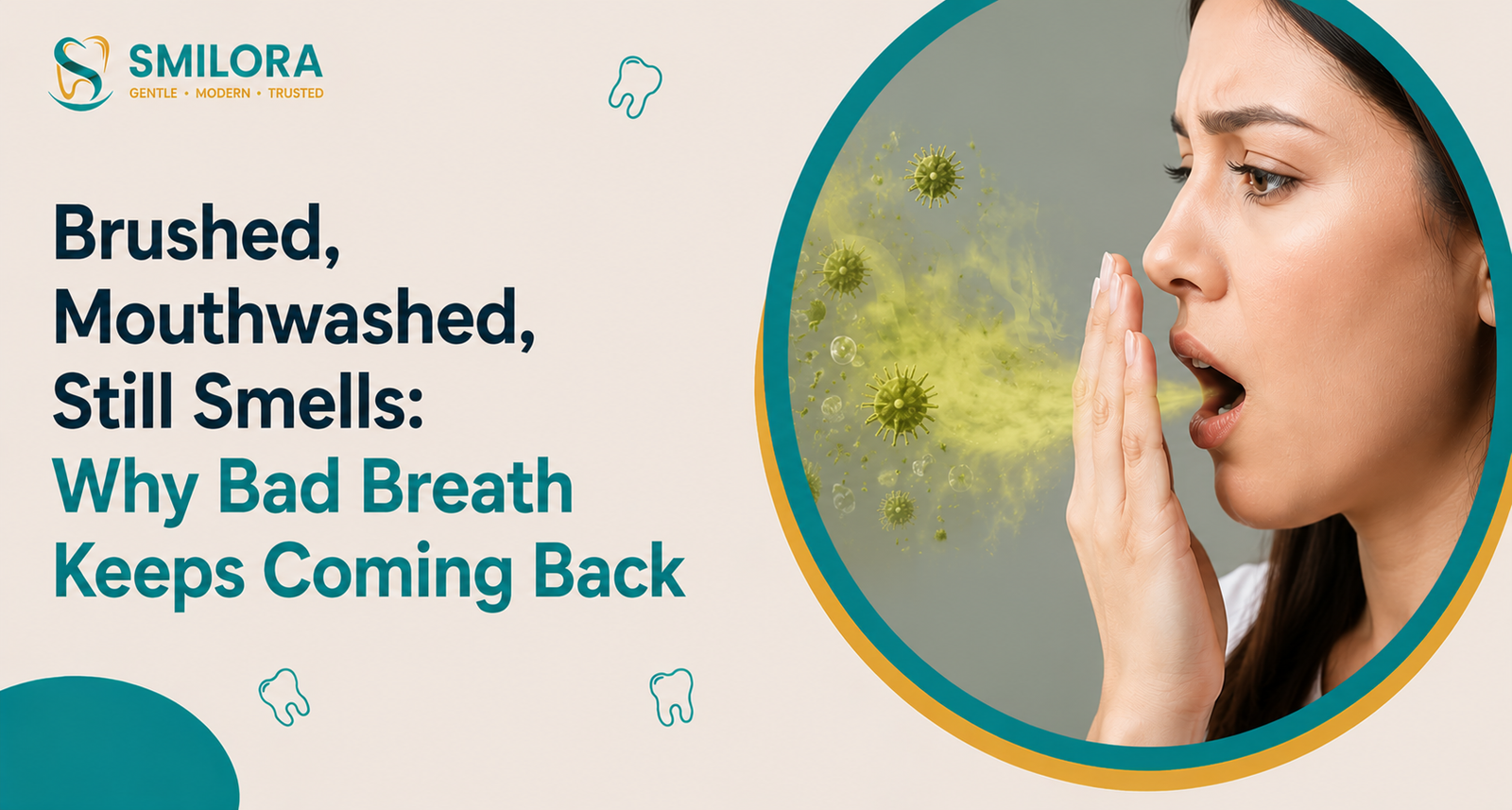
You brush. You use mouthwash. Maybe you even carry mints in your bag just in case. And yet, somehow, your breath still doesn’t feel fresh. If this sounds familiar, you’re not alone — persistent bad breath, or halitosis, is one of the most common reasons people search for a dentist, and also one of the most misunderstood.
Chronic bad breath usually comes from bacteria on the tongue, gum disease, or hidden tooth decay, not from what you ate. Mouthwash masks the smell temporarily but doesn’t treat the source, which is why it keeps coming back.
Mouthwash only covers the smell for a little while. It doesn’t fix what’s actually causing it. If the problem keeps returning, it’s worth understanding what’s really going on in your mouth.
Where Bad Breath Actually Comes From
Almost all bad breath starts with bacteria. Your mouth hosts hundreds of different bacterial strains, and when food particles are left behind, these bacteria break them down and release odour as a byproduct. Brushing and flossing normally keep this in check — but there are a few common hiding spots that brushing alone doesn’t reach.
The Tongue Is Usually the Real Culprit
Most people brush their teeth and skip their tongue entirely. The back of the tongue is one of the biggest breeding grounds for odour-causing bacteria. If you’ve never used a tongue scraper, this alone could be the missing piece.
Common Causes of Persistent Bad Breath
- Poor brushing and flossing habits, especially skipping the tongue
- Dry mouth, since saliva naturally washes away bacteria and food particles
- Gum disease, which often shows up as bad breath that won’t go away
- Tooth decay or old fillings that trap bacteria
- Certain foods like garlic and onion, which release odour through the bloodstream, not just the mouth
- Smoking or tobacco use
- Sinus issues or postnasal drip
- Skipping meals or very low-carb diets, which can cause a distinct breath odour
When It’s More Than Just Breath
If bad breath is paired with bleeding gums, tooth sensitivity, or a lingering bad taste, it’s often a sign of something happening below the surface — early gum disease or a cavity that hasn’t been noticed yet. In these cases, no amount of mouthwash will solve it, because the source isn’t on the surface.
What Actually Helps
- Brush twice daily and don’t forget to gently clean your tongue
- Floss every day to remove food particles brushing misses
- Stay hydrated, since a dry mouth is a major cause of odour
- Cut back on tobacco and sugary or highly processed foods
- Replace your toothbrush every 3 to 4 months
- Don’t rely on mouthwash as a long-term fix — treat it as a top-up, not a solution
When to See a Dentist
If your bad breath has stuck around for weeks despite doing everything right, it’s time to look deeper than your bathroom cabinet. At Smilora Dental Clinic, Chembur, we look for the actual source — whether it’s a hidden cavity, early gum disease, or something else — so you get a real fix instead of a temporary cover-up. Fresh breath shouldn’t feel like a full-time job.
📍 Smilora Dental Clinic, Chembur, Mumbai
Reviewed by [Dr. Binal Shah], BDS/MDS — Smilora Dental Clinic, Chembur
Frequently Asked Questions
Why does my breath still smell bad even after brushing and using mouthwash?
Because mouthwash only masks odour temporarily — it doesn’t remove the bacteria hiding on your tongue, in gum pockets, or inside cavities. If the source isn’t treated, the smell returns within hours.
Can bad breath be a sign of gum disease?
Yes. Persistent bad breath that doesn’t improve with brushing is one of the earliest signs of gum disease, since bacteria below the gumline release odour as they break down tissue.
How do I know if my bad breath is from my stomach or my mouth?
Most chronic bad breath (over 85% of cases) originates in the mouth, not the stomach. If brushing your tongue and flossing don’t help within a couple of weeks, a dental check-up will confirm whether the cause is gum-related, a cavity, or something else.